
Germany Jobseeker Visa
)
Nadia Dardón
Immigration Content Writer
Last update
)

Germany Rating from Citizen Remote
Overall  3.4
3.4

Internet Infrastructure 4.0
Country Stability 5.0
Cost of Living 3.0
Ease of Obtaining Visa 1.0
Taxes 4.0
Quick Visa Facts

Visa length Up to 6 months.

Possible to extend? No. You must leave if you don’t find a job. If you do, you can switch to a work permit.

Who can apply? Non-EU professionals with a recognized degree or vocational qualification.

Minimum Income Requirements About €1,027–€1,091 per month (≈ $1,120–$1,190 USD/month), or roughly €6,200–€6,500 total for six months

Time for visa applications Usually 4–12 weeks, depending on the embassy.
Want to know if you can apply?
Complete a visa quiz and see if you qualify!
Germany has long been one of Europe’s strongest economies, a global hub for engineering, technology, healthcare, and skilled trades. If you’ve been considering taking your career there but don’t yet have a job offer, the German Jobseeker Visa could be your pathway in.
This visa enables qualified professionals from non-EU countries to enter Germany and seek employment on the ground. Instead of applying blindly from abroad, you get the opportunity to attend interviews, network with employers, and position yourself directly within the German job market.
In this comprehensive guide, we’ll walk you through the eligibility requirements, required documents, application steps, costs, processing times, and what happens after you find a job, all explained in a straightforward, practical, and easy-to-follow manner.
If Germany is on your career radar, let’s break down exactly how the Jobseeker Visa works and whether it’s the right path for you.

Germany Jobseeker Visa Overview
The German Jobseeker Visa (Visum zur Arbeitsplatzsuche) is a temporary long-stay national visa designed to help skilled professionals from non-EU countries enter Germany without a job offer and search for employment on the ground. It fits into Germany’s broader framework of skilled immigration policies aimed at addressing labour shortages in key sectors.
This visa provides a structured opportunity to explore the German job market firsthand, attending interviews, networking with employers, and evaluating career options, all while residing legally in Germany for a defined period. It’s a practical alternative to applying remotely from your home country and gives you direct access to in-person opportunities in one of Europe’s largest economies.
While Germany continues to evolve its immigration system and introduce related pathways like the Chancenkarte/Opportunity Card with different requirements and durations, the Jobseeker Visa remains a well-known route for foreign professionals to start their job search journey in Germany.
Who Is It For?
The German Jobseeker Visa is aimed at qualified professionals and skilled workers from outside the EU/EEA/Switzerland who want to enter Germany without a pre-existing job offer and look for employment that matches their academic or vocational qualifications.
It’s particularly relevant if you:
Have a recognized university degree or comparable qualification.
Wish to explore job opportunities directly in Germany.
Want to attend job interviews or make professional connections in person.
Citizens of some countries (like the USA, Canada, Australia, Japan, South Korea, Israel, and New Zealand) can also enter Germany visa-free for short stays and then apply for a jobseeker permit from within the country, but most others must apply at a German diplomatic mission before travelling.
What Does It Allow You to Do?
Under this visa, you can:
Live in Germany for up to six months to actively search for a job that matches your skills and qualifications.
Attend interviews and network with German employers in person.
Once you find a suitable job, apply to convert your stay into a work residence permit or an EU Blue Card without needing to leave Germany.
It’s important to note that the Jobseeker Visa itself does not automatically allow employment during the job search period; its primary purpose is to enable the search. Only after finding employment and switching to the corresponding residence permit can you begin working.

Germany Jobseeker Visa Requirements
When applying for the German Jobseeker Visa, you’ll need to prepare and submit several documents that prove your identity, qualifications, financial stability, and ability to stay in Germany for the duration of your job search. The exact checklist can vary slightly by German embassy or consulate, so it’s always best to check the specific requirements on the website of the mission where you’ll apply.
These are the standard documents almost every applicant must prepare:
Completed the Germany visa application form (national visa)
Valid passport with at least several months of validity beyond your planned stay.
Copies of the passport data page.
Biometric passport photos meeting German specifications.
Personal cover letter explaining your plans to seek employment in Germany.
Curriculum Vitae (CV/Resume) detailing your educational and professional background.
Declaration of accuracy confirming that all submitted information is true.
Proof of accommodation in Germany (hotel reservation, rental agreement, invitation letter, etc.)
Proof of Financial Self-Sufficiency
One of the most important requirements for the German Jobseeker Visa is demonstrating that you can financially support yourself during your stay in Germany without recourse to public funds. This means showing the German authorities that you have access to sufficient funds to cover your living expenses for the full duration of your job search, usually up to six months.
The typical benchmark many missions refer to when evaluating financial proof is around €1,027 to €1,091 per month of intended stay, equivalent to approximately $1,218 to $1,293 per month.
You can demonstrate this in several ways:
Blocked Account (Sperrkonto): A German blocked account funded with the equivalent of the required monthly amounts multiplied by your intended stay. The full amount must be deposited upfront and remains largely inaccessible until you arrive in Germany, with only limited monthly withdrawals allowed.
Formal Declaration of Commitment (Verpflichtungserklärung): A legally binding letter from a sponsor in Germany (often a friend or relative) who guarantees to cover your expenses.
Personal Bank Statements or Proof of Funds: Some missions accept bank statements showing savings equal to the necessary amount for six months.
The key idea is that visa officers must be convinced you won’t fall short financially during your stay. Exact figures can vary slightly between consulates and may be updated periodically, so always check the official mission’s instructions before applying.
Private Health Insurance
Valid health insurance coverage is a crucial part of your Jobseeker Visa application. You need proof of health insurance that covers you from your date of entry until you qualify for statutory or private health insurance in Germany.
This insurance must be recognised as valid by the German authorities and should ideally include:
Coverage for medical costs, including outpatient and inpatient care.
Emergency treatment and repatriation (in case of serious illness or accident)
Coverage for the entire period before you obtain a German health insurance plan.
Most applicants use international travel health insurance or private health plans that can be documented and submitted with their visa application. The consulate will specify minimum coverage levels on its website.
Proof of Professional Qualifications
To qualify for the Jobseeker Visa, you must show that you are a qualified professional whose skills are relevant to the German labor market. This generally includes:
Degree certificates (university or equivalent) or vocational training credentials.
Transcripts or certificates showing your field of study or trade.
Where applicable, a recognition of your foreign qualification in Germany.
The goal here is to prove your education and experience are comparable to German standards, especially in sectors facing skill shortages.

How to Apply for the Germany Jobseeker Visa—Step-by-Step Instructions
Applying for the German Jobseeker Visa is a structured process handled through German embassies and consulates abroad. While small details may vary depending on your country of residence, the overall procedure follows the same national framework set by the German Federal Foreign Office.
Step 1: Check Your Eligibility
Before scheduling an appointment, ensure that your academic or vocational qualification is recognized or comparable to a German qualification. Recognition plays a central role in whether your application is approved.
The official government portal Make it in Germany provides guidance on checking recognition status and whether your degree meets German standards. If formal recognition is required in your profession, you should complete that process before applying.
Step 2: Book an Appointment with the German Mission
Applications must be submitted in person at the German embassy or consulate responsible for your place of residence. Appointments are usually scheduled online through the official website of the relevant German mission.
In some countries, appointment availability can be limited, so booking early is strongly recommended. You cannot apply by mail or upon arrival in Germany (unless you are from a visa-exempt country permitted to apply from within Germany).
Step 3: Submit Your Application in Person
At your appointment, you will:
Submit your completed application.
Provide biometric data (such as fingerprints)
Pay the applicable visa fee (generally €75)
Answer questions about your professional background and job search plans.
The visa officer may ask about your intended field of employment, how you plan to search for work, and how you will support yourself during your stay. This is a normal part of the evaluation process.
Step 4: Application Review and Processing
After submission, your application is reviewed by the embassy or consulate. In some cases, German authorities may verify your qualifications or request additional clarification.
Processing times vary depending on the country, application volume, and complexity of the case. It can take several weeks, so applicants should plan accordingly and avoid booking non-refundable travel arrangements before approval.
Step 5: Receive Your Visa and Travel to Germany
If approved, the Jobseeker Visa will be issued as a national long-stay visa (D visa), typically valid for up to six months.
After arriving in Germany, you must register your address at the local registration office (Anmeldung). During your stay, you are expected to actively search for employment that matches your qualifications.
If you secure a qualifying job offer, you can apply for a residence permit for employment (or potentially an EU Blue Card) at the local immigration office without needing to leave Germany.

Stay Requirements and Conditions
The German Jobseeker Visa is typically issued for a maximum period of six months. During this time, you are permitted to reside in Germany strictly for the purpose of seeking qualified employment that matches your academic or vocational background. The visa is temporary and cannot usually be extended beyond its initial validity period. If you do not secure employment within the allowed timeframe, you are expected to leave Germany before your visa expires.
While in Germany, you must maintain valid health insurance coverage for your entire stay and ensure that you continue to meet the financial self-sufficiency requirement under which your visa was granted. This means you must be able to support yourself without relying on German public funds or social assistance. Authorities may request proof that these conditions remain fulfilled if necessary.
The Jobseeker Visa does not automatically authorize full employment. Its primary purpose is to allow you to search for a job, attend interviews, and network professionally. Only after securing a qualifying job offer can you apply for a residence permit for employment or an EU Blue Card at the local immigration office (Ausländerbehörde). You may only begin working once the appropriate residence permit has been approved.
Additionally, once you arrive in Germany, you are required to register your address (Anmeldung) at the local registration office within the legally prescribed period, usually within two weeks of moving into accommodation. This registration is mandatory for all residents in Germany and is necessary for many administrative processes, including opening a bank account or applying for a residence permit.
Finally, it is important to respect the conditions tied to the visa category. The Jobseeker Visa is intended for job searching in Germany only and does not serve as a pathway for freelance activity or long-term residence without transitioning to a proper work-based residence permit. Remaining compliant with these stay conditions ensures a smooth transition if you successfully obtain employment and apply for a longer-term residence status.
How Much Does the Germany Jobseeker Visa Cost?
The standard government fee for the German Jobseeker Visa is €75, as set by the German Federal Foreign Office for national (D) visas. Based on a recent exchange rate (approximately 1 EUR ≈ 1.09 USD), this equals roughly $82 USD. The exact USD equivalent may vary slightly depending on the exchange rate applied by the German mission in your country at the time of payment.
The visa fee is typically paid at the embassy or consulate during your appointment. In most cases, it must be paid in the local currency equivalent, and payment methods (cash, card, or bank draft) depend on the specific German mission. The fee is generally non-refundable, even if your application is refused.
In addition to the official visa fee, applicants should budget for related costs, which may include:
Costs for document translations and certifications.
Recognition of foreign qualifications (if required)
Biometric photographs.
Health insurance coverage for the full stay.
Setting up a blocked account (if applicable), including potential service fees.
Travel expenses to attend the visa appointment.
If your visa is approved and you later secure employment in Germany, you will also need to pay a separate fee when applying for your residence permit or EU Blue Card at the local immigration office. Residence permit fees typically range from €100 to €140 (approximately $109 to $153 USD), depending on the permit type and duration.
Because additional administrative costs can add up, it’s wise to calculate your full expected expenses before beginning the application process.

Taxes for People With a Germany Jobseeker Visa
If you are in Germany on a German Jobseeker Visa, your tax situation is generally straightforward, at least at the beginning.
During the job search period, you are not authorized to take up regular employment, which means you typically will not have German employment income and therefore will not be subject to German income tax. The visa is designed strictly for seeking work, not for earning income.
However, tax obligations begin once you secure employment and transition to a residence permit for work (such as a standard employment residence permit or an EU Blue Card). From that point onward, your tax responsibilities are the same as those of any other employee in Germany.
Germany applies a progressive income tax system. As an employee, income tax (Einkommensteuer) is automatically deducted from your salary through payroll withholding. In addition to income tax, employees also contribute to:
Pension insurance
Health insurance
Unemployment insurance
Long-term care insurance
Solidarity surcharge (in some cases)
Church tax (if you are officially registered as a member of a recognized church)
Tax rates vary depending on your annual income and tax class. Germany’s income tax rates range from approximately 14% to 45%, depending on earnings. Your tax class is determined by factors such as marital status and family situation.
If you remain in Germany for more than 183 days in a calendar year and establish residence (which you do by registering your address), you are generally considered a tax resident. This means Germany may have the right to tax your worldwide income during that period. If you have income from abroad while living in Germany, you may need to review double taxation agreements between Germany and your home country.
It’s also important to note that once employed, you will receive a tax identification number (Steueridentifikationsnummer) automatically after registering your address. Your employer will use this number to process payroll and tax deductions.
In short, while the Jobseeker Visa itself does not usually create immediate tax obligations, your tax responsibilities begin as soon as you start working under a valid residence permit. Because tax situations can vary depending on personal circumstances, consulting a tax advisor (Steuerberater) is advisable once you transition into employment.
Living in Germany with the Germany Jobseeker Visa
Living in Germany with the Jobseeker Visa offers you the opportunity to experience daily life in one of Europe’s strongest economies while actively exploring career opportunities. During your stay, you’ll be immersed in Germany’s structured, efficient systems, from reliable public transportation and healthcare to well-organized city administrations. Major cities like Berlin, Munich, Hamburg, and Frankfurt provide dynamic job markets and international communities, while smaller cities often offer lower living expenses and strong regional industries. Because your stay is temporary and focused on job searching, budgeting carefully and choosing accommodation strategically can make a significant difference in managing expenses.
At the same time, adjusting to life in Germany means understanding local regulations and expectations. Registering your address (Anmeldung) shortly after arrival is mandatory and necessary for many administrative processes. While English is widely spoken in many professional environments, especially in tech and multinational companies, learning German can significantly improve both your employment prospects and daily life experience. The Jobseeker Visa allows you to build professional networks, attend interviews, and gain firsthand insight into German workplace culture, all of which can help you transition smoothly into long-term residence once you secure employment.
Best Cities to Live in Germany
Choosing the right city can significantly impact your job search experience in Germany. While opportunities exist across the country, some cities stand out for their strong job markets, international communities, and overall quality of life.
Berlin

Germany’s capital, Berlin, is known for its vibrant startup ecosystem, growing tech sector, and international workforce. It offers relatively affordable living costs compared to other major German cities, which can be helpful during your job search period. Berlin is particularly attractive for professionals in IT, digital media, creative industries, and research. English is widely spoken in many professional environments, making it one of the most accessible cities for newcomers.
Munich
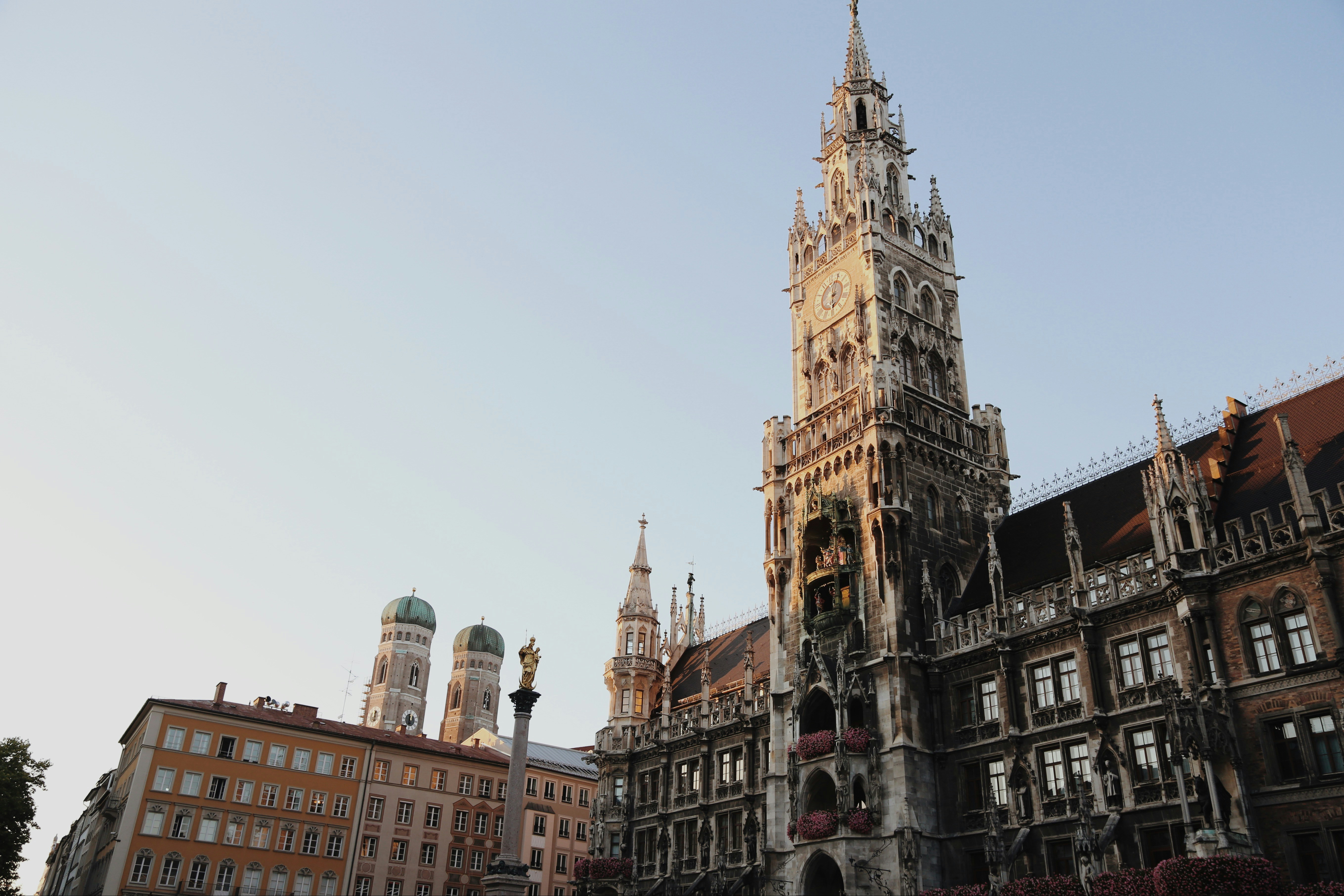
Munich is Germany’s economic powerhouse and home to major global companies in automotive, engineering, finance, and technology. It consistently ranks among Germany’s cities with the highest quality of life. While the cost of living is higher than in most other cities, salaries are often correspondingly strong. Munich is particularly appealing for engineers, IT professionals, and specialists in high-tech industries.
Hamburg

As Germany’s largest port city, Hamburg offers a strong economy driven by logistics, trade, aviation, renewable energy, and media. It combines a thriving business environment with a high quality of life, beautiful waterfront views, and a slightly more relaxed atmosphere than some southern cities. Hamburg is a strong choice for professionals in international trade, supply chain management, engineering, and creative industries.
Cost of Living
The official currency of Germany is the euro (€). €1 ≈ $1.18 USD
The average net monthly salary in Germany is around €2,850–€3,000, which equates to approximately $3,360–$3,540 USD per month.
Here’s a rundown of what you should expect to pay in different cities:
Berlin
Rent (1 bedroom in city center) ≈ $1,100–$1,350 per month
Rent (3 bedrooms outside city center) ≈ $1,500–$1,900 per month
Basic Utilities ≈ $300–$350 per month
Wi‑Fi ≈ $30–$40 per month
Public Transport one‑way ≈ $1.90–$3.00
Groceries (2 people) ≈ $450–$650 per month
Munich
Rent (1 bedroom in city center) ≈ $1,500–$2,150 per month
Rent (3 bedrooms outside city center) ≈ $2,100–$2,750 per month
Basic Utilities ≈ $320–$380 per month
Wi‑Fi ≈ $30–$40 per month
Public Transport one‑way ≈ $2.00–$3.00
Groceries (2 people) ≈ $500–$750 per month
Hamburg
Rent (1 bedroom in city center) ≈ $1,200–$1,700 per month
Rent (3 bedrooms outside city center) ≈ $1,700–$2,300 per month
Basic Utilities ≈ $290–$350 per month
Wi‑Fi ≈ $30–$40 per month
Public Transport one‑way ≈ $2.00–$3.00
Groceries (2 people) ≈ $450–$700 per month
FAQs
How long is the Germany Jobseeker Visa valid?
The German Jobseeker Visa is typically issued for up to six months. During this time, you are allowed to stay in Germany strictly for the purpose of seeking qualified employment. The visa generally cannot be extended beyond its original validity period, so if you do not secure a job within that timeframe, you are expected to leave Germany.
Can I work while on a Germany Jobseeker Visa?
No, the Jobseeker Visa does not automatically grant permission to work. Its purpose is to allow you to search for employment, attend interviews, and network with employers. You may only begin working after securing a job offer and obtaining the appropriate residence permit for employment or an EU Blue Card.
What happens if I find a job during my stay?
If you receive a qualifying job offer that matches your academic or vocational background, you can apply for a residence permit for employment at the local immigration office (Ausländerbehörde) in Germany. In most cases, you do not need to leave Germany to switch to a work residence permit.
Can I bring my family with me on a Jobseeker Visa?
The Jobseeker Visa is intended for individual applicants. Family reunification is generally not permitted during the job search period. However, once you obtain a valid residence permit for employment, your spouse and children may become eligible to apply for family reunification, depending on your residence status and income level.
Is German language proficiency required?
There is no universal minimum German language requirement explicitly set for all Jobseeker Visa applicants. However, depending on your profession and the recognition process for your qualifications, language skills may be required or strongly recommended. In practice, having at least basic German proficiency can significantly improve your job prospects and daily life experience in Germany.
Author
)
Nadia Dardón is a content creator from Guatemala. She has worked fully remotely for the past six years as a copywriter, editor, and content creator, working for different industries. She started her digital nomad journey in 2022 and currently lives as an expat in Spain.


